Crochet Hook Size for Amigurumi: A Chart by Yarn Weight
For amigurumi, use a hook two or three sizes smaller than the one on the yarn label. With DK yarn that usually means 2.5 mm, with worsted 3.0 to 3.5 mm. The smaller hook makes dense fabric that hides the stuffing and holds its shape, which is what a toy needs.
The chart
This table pairs each common yarn weight with the label hook and the hook to use for toys.
| Yarn weight | Hook on the label | Hook for amigurumi | First toy size* | Eye size |
|---|---|---|---|---|
| Sport / 4-ply | 3.0 to 3.5 mm | 2.0 to 2.5 mm | 8 to 10 cm | 6 mm |
| DK / light worsted | 3.75 to 4.5 mm | 2.5 mm | 10 to 13 cm | 6 to 8 mm |
| Worsted / aran | 4.5 to 5.5 mm | 3.0 to 3.5 mm | 13 to 17 cm | 8 to 10 mm |
| Bulky / chunky | 6.0 to 8.0 mm | 4.0 to 5.0 mm | 18 to 25 cm | 12 mm and up |
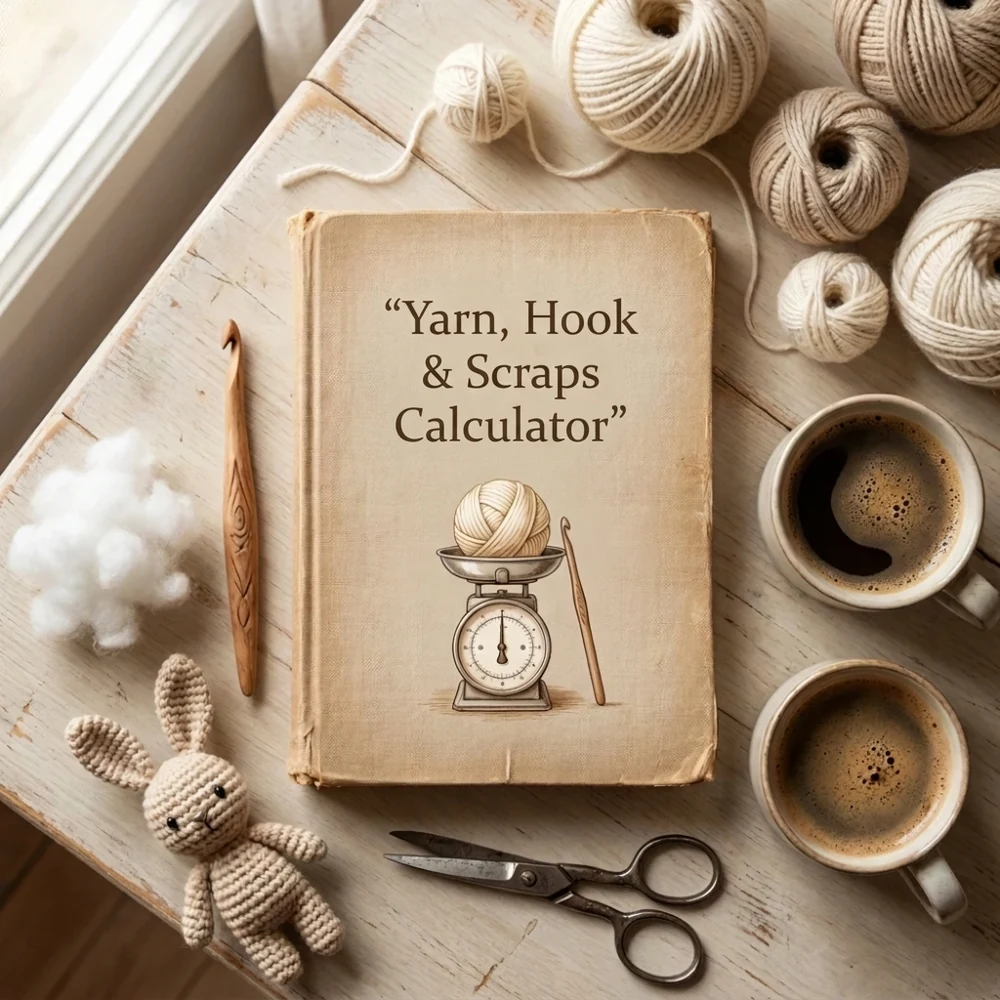
*For a typical small pattern whose head grows to 30 or 36 stitches. Larger patterns scale up the same way. These ranges come from the Yarn, Hook & Leftover Calculator, one of the bonus guides in 1,947 Amigurumi Patterns.
If you do not know the weight of a yarn with no label, wrap it around a ruler. Nine wraps per inch is about worsted. Then use the matching row.
Why the hook is smaller than the label
A ball band recommends a hook for a scarf or sweater, where you want fabric that drapes and breathes. A toy is the opposite: it is a skin around a lump of stuffing, and every gap between stitches is a window. Going down two or three sizes does four things at once:
- It hides the stuffing. Tight stitches mean no fluff peeking through the seams or the widest round.
- It holds the shape. A dense sphere stays round when you squeeze it. A loose one goes lumpy.
- It grips safety eyes. The eye post sits snug between two stitches instead of sliding around.
- It survives a child. Tight fabric does not snag on fingers or buttons.
You are not learning a special toy stitch. It is plain single crochet with a smaller hook than you would expect.
What size hook for amigurumi, step by step
- Name the weight of your yarn (label, or wrap test).
- Find the row in the chart and take the lower number first.
- Crochet a flat circle for four rounds: 6, 12, 18 and 24 stitches.
- Press it with your thumb and hold it to a window.
- Adjust: see too much light, go down one hook size. If the hook jams in every stitch, you have gone too small, so go up a little.
How tight is tight enough?
- You cannot push a fingertip between two stitches.
- The flat circle does not ripple or curl up at the edge.
- Holding it up to the light you see only thin pinpoints, not holes.
- The hook still slides into each stitch without a fight.
Tight fabric feels stiff for the first twenty minutes. Loosen your grip on the hook, not your stitches, and let the hook do the work.
Common cases
- DK cotton, ball band 4.0 mm: use 2.5 mm. Three steps down is the usual setup. If the fabric is stiff as cardboard, try 2.75 mm.
- Worsted acrylic, ball band 5.0 mm: use 3.5 mm. For tight cotton worsted, 3.0 mm.
- Sport weight, ball band 3.25 mm: use 2.25 mm. Small toys and small stitches; good light helps.
- Milk cotton DK, ball band 3.5 mm: use 2.5 mm. It is soft and a little splitty, so a hook with a rounded head helps.
Changing the hook changes the toy
Swapping yarn and hook together changes the finished size and the amount of yarn used, but not the pattern. DK on a 2.5 mm hook gives a toy about 12 cm tall in one popular first pattern; worsted on a 3.5 mm hook gives about 15 cm of the same toy and needs roughly twice the grams. The eyes should follow: a bigger head needs a bigger eye, so go up a size when the toy grows. For more on yarn choice, see the best yarn for amigurumi.
Reading hook sizes
Hooks are labelled in millimetres on almost every modern brand. Letter and number sizes vary between brands, so use the millimetre value to compare. If a pattern gives only a letter size, check the pattern's legend or ask the designer. For help with the rest of the shorthand, see how to read a crochet pattern.
Go deeper
The Yarn, Hook & Leftover Calculator in 1,947 Amigurumi Patterns has the full chart above, a chapter on why the label is wrong for toys, and an eye-size table for heads from 24 to 48 stitches. The First Plush Handbook adds a chapter that walks through the same rule with a flat-circle test. If you are choosing a first project to try your new hook on, the guide to your first amigurumi patterns lists the easiest shapes.