Best Yarn for Amigurumi: How to Choose by Project
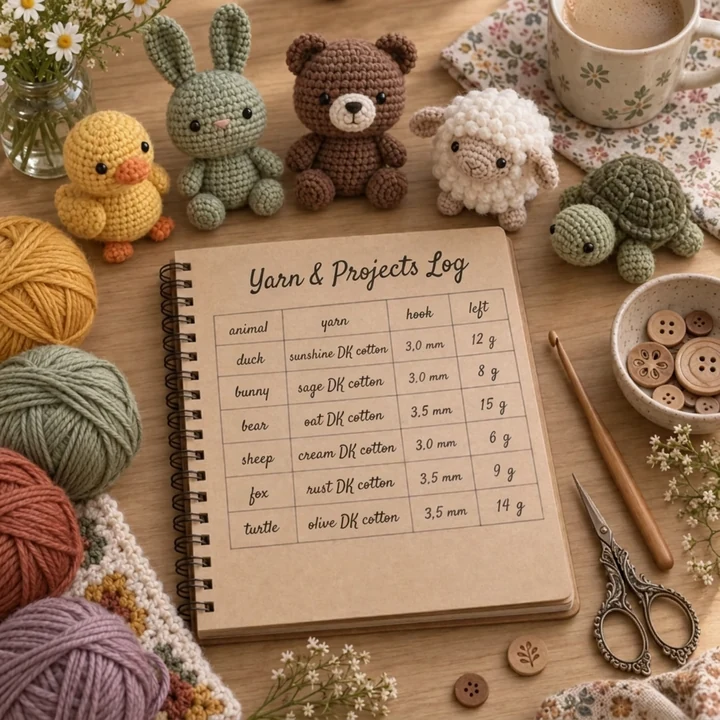
For a first amigurumi, choose a smooth, light-coloured DK cotton and work it with a small hook. Cotton shows every stitch, does not stretch, and holds its shape when the toy is squeezed. That does not make everything else wrong: acrylic, milk cotton and blends all make good toys. The right yarn depends on what you are making, who will hold it, and how it will be washed.
Why yarn choice matters more for toys
A toy is a thin skin around a lump of stuffing. That puts different demands on yarn than a scarf or a sweater does.
- Stitches should be countable. You work in rounds with a marker and check a stitch count at the end of each round. Yarn that hides stitches makes that hard.
- The fabric must be dense. Gaps let stuffing show. A yarn that is firm and slightly stiff makes a tight fabric easier to achieve.
- The toy gets squeezed, dropped and washed. The fibre decides how it looks after a month of that.
- Yarn amounts are small. A small toy uses a few ounces at most, so leftover yarn from other projects is often enough.
Yarn weight: what to pick
Yarn weight is the thickness of the strand. The weight plus the hook decides how big the finished toy turns out, using the same pattern.
| Yarn weight | Hook for amigurumi | Typical first toy size | Good for a first project? |
|---|---|---|---|
| Sport / 4-ply | 2.0 to 2.5 mm | 8 to 10 cm | Fiddly. Small stitches, good light needed. |
| DK / light worsted | 2.5 mm | 10 to 13 cm | Yes. The usual default. |
| Worsted / aran | 3.0 to 3.5 mm | 13 to 17 cm | Yes. A larger toy, about twice the yarn of DK. |
| Bulky / chunky | 4.0 to 5.0 mm | 18 to 25 cm | Later. Fast, but harder to count. |
These ranges come from the Yarn, Hook & Leftover Calculator, one of the bonus guides in 1,947 Amigurumi Patterns, and assume a typical small toy pattern, where the head grows to around 30 or 36 stitches. Larger patterns scale up in the same way.
Note the hook sizes. They are two or three sizes smaller than the hook on the yarn label, which is deliberate. The hook size guide explains why.
What changes when you swap yarn weights
The rounds and stitch counts of a pattern do not change when you use a different yarn. Three things do:
- Size. Worsted instead of DK makes the toy roughly a quarter to a third taller. Sport instead of DK makes it about a fifth smaller.
- Grams. Worsted uses about twice the grams of DK for the same pattern. Plan the amount before you start.
- Eyes. A bigger head needs bigger eyes. Eyes that are too small make the face look sleepy; too large and it looks startled.
Fibre: cotton, acrylic and the rest
This is the choice most people ask about. The comparison below is based on how yarns behave on a squeezed, hugged and washed toy.
| Fibre | Stitch definition | Pilling | Washing | Feel | First toy? |
|---|---|---|---|---|---|
| Cotton (DK) | Crisp, every V shows | Very low | Hand wash, cool | Firm, cool | Yes, the best choice |
| Milk cotton | Good, softer | Low | Hand wash, gentle | Soft, matte | Yes |
| Acrylic (worsted) | Good | Medium, fuzzes where held | Machine, cool, in a bag | Light, warm | Yes |
| Cotton-acrylic blend | Good | Low to medium | Machine, cool, in a bag | Soft | Yes |
| Wool | Good | Medium | Hand wash, cold; can felt | Warm, springy | Not for children's toys |
| Chenille / velvet | None; you cannot see stitches | Sheds on some brands | Gentle, air dry | Very soft | No, later |
| Blanket / bulky chenille | None | Sheds | Gentle | Pillowy | No, later |
Cotton
Cotton is the safe default. It does not stretch, so a sphere keeps its shape. Every V shows, so counting is easy. It survives washing and it barely pills. The downside is that it can feel stiff for the first twenty minutes, because tight fabric asks you to loosen your grip on the hook rather than the stitch. Cotton can shrink a little in a hot wash, so wash the finished toy cool.
Acrylic
Acrylic is light, warm and widely available, and it is what most leftover drawers contain. It makes good stitches, but it fuzzes where hands hold it most, usually the tummy and the back of the head. A sweater stone or a fabric razor cleans that up in a minute. Acrylic tolerates a cool machine wash inside a pillowcase.
Milk cotton and blends
These sit in between. Milk cotton is soft and matte and still shows stitches, but it can be splitty, so a hook with a rounded head helps. Cotton-acrylic blends give a softer feel and a gentler wash.
Wool
Wool is warm and springy, but it can felt in the wash, and it is not a good choice for children's toys that will be laundered.
Chenille and velvet
Chenille is lovely on a finished toy. You just cannot see the stitches, so you cannot find stitch one, count a round or pull back a mistake without shedding. Make three or four toys in cotton first. Then it is a treat, not a trap.
Colour and texture
- Choose a light, smooth main colour. It shows your stitches and makes eyes stand out.
- Use one main colour and one contrast. The contrast covers the muzzle, inner ears or belly. About eighty percent of the grams go into the main colour and twenty into the contrast.
- Avoid loosely twisted yarn. It splits on a small hook and makes the whole toy frustrating. Use it for a scarf, not a toy.
- Do not buy twelve new skeins. One main colour plus a scrap of contrast is enough for a first toy.
Using what you already have
Half a skein of DK or worsted from an old project is exactly the right amount for a first toy, as long as it is smooth and light. Weigh it, look up the size class and match the toy to the grams. As a rough guide from the Calculator, a small DK toy of around 10 cm needs about 15 grams, a DK toy of around 15 cm needs about 38 grams, and a medium worsted toy of around 16 cm needs about 55. Leave a margin of ten percent, because running out on the last ear is the worst moment in the hobby.
If you have no scale, measure by length instead. One gram of DK cotton is about 2.2 metres, and one gram of worsted is about 1.7 metres.
Care and safety notes
- Copy a care line onto the gift tag so the toy outlives its first wash: for cotton, hand wash cool and dry flat; for acrylic, machine wash cool inside a pillowcase.
- Safety eyes can come loose in a hot dryer. Embroidered eyes are the usual choice for babies and toddlers; the U.S. Consumer Product Safety Commission (CPSC) publishes guidance on small parts and toys for young children, and it is worth reading before you give a toy to a very young child.
- Keep yarn tails short and buried so they do not tangle in the stuffing.
A simple decision path
- Weigh your yarn. Name its weight (wrap it around a ruler if the label is gone).
- Choose a hook two or three sizes smaller than the label.
- Match the toy class to your grams, with a ten percent margin.
- Check the colour: light and smooth for toy one, dark for details.
- Choose the eye size to match the head.
Once your first toy is done, you can try other fibres without worrying about whether the yarn is the problem. For help with the next step, the guide to your first amigurumi patterns lists the easiest shapes to start with, and how to read a crochet pattern explains the notation inside them.
Go deeper
The Yarn, Hook & Leftover Calculator in 1,947 Amigurumi Patterns turns these guidelines into tables you can pin above your table: yarn weight against hook and finished size, how many grams a small, medium or large toy needs, a fibre comparison for squeezed toys, and the safety-eye size that matches each head. It also has a worked example of 84 grams of worsted and printable leftover cards you can clip to each ball, so Saturday's drawer is already sorted.